The Work: Technique and Idea
Silkscreen printing is a reproductive technology — designed to generate multiples, to disseminate an image across any number of surfaces, to make the copy not just possible but the point. The method here takes the opposite position. The screen is prepared in the traditional way, the image exposed through photo emulsion, but then the process is redirected at the moment of printing. Rather than transmitting the image onto a secondary surface — paper, fabric, the conventional receivers — oil paint is extruded directly into and through the mesh itself. The screen becomes the ground. There is no secondary surface. There is no copy. The mesh, saturated and structured by paint forced through it under pressure, is the painting, and it exists once, unrepeatable, bonded to the specific conditions and decisions of its making in a way that no print ever is or can be.
This is not a technical refinement of silkscreen. It is a structural inversion of it — the apparatus of multiplication turned against its own logic to produce the singular object. The method that was designed to defeat uniqueness becomes, through this redirection, its guarantor.
The implications of this are not merely formal. A painting made this way is a relic in the strict sense: an object whose meaning is inseparable from its physical existence, that bears within its substance the trace of its making, that cannot be reproduced without becoming something categorically different. The paint in the mesh is not a representation of a surface; it is the surface. The relief — and in the fully extruded works this relief is considerable, the letters and forms rising from the mesh ground with their own weight and shadow — is not applied. It is constituted. The object and the image are the same thing. And because the paint remains oil paint, workable and responsive in the period before it dries, the extruded form is not the end of the process but the beginning of another. The relief can be worked, adjusted, drawn into, modulated — all the intimacy and directness of oil painting remains available, layered now on top of a structure that conventional painting cannot produce. The hand withdraws in printmaking at the moment of printing. Here it continues.
This matters philosophically because it collapses a distinction that Western painting has largely taken for granted: the distinction between ground and image, between the surface that receives and the marks that signify. Here there is no ground beneath the image waiting to be covered. The mesh is simultaneously structure, support, and image. Paint is simultaneously medium, mark, and object. The usual hierarchy — support subordinated to surface, surface subordinated to image, image subordinated to meaning — is refused from the start.
The paintings are displayed off their stretchers, pinned directly to canvas rather than hung in the conventional manner. This is a partial concession to the practicalities of how art is bought and lived with — the ideal presentation would have the work pinned directly to the wall, no canvas, no stretcher, no intervening support, the painted mesh hanging flat against the surface the way a flag hangs against its pole or a relic against its reliquary wall. In that ideal state the work refuses the declaration that a stretched canvas makes — that painting is an illusionistic object, a window, a view, something that opens a fictional space behind it. Pinned flat to the wall, the work is emphatically a surface, a skin, coplanar with its support, carrying meaning through presence and materiality rather than through the fiction of depth. The pins are visible, deliberate, structural — they acknowledge the act of hanging as part of the work's meaning rather than concealing it. The canvas is a bridge; the wall is the destination.
The borders of the works are painted and treated separately, often incorporating layered glazes and accumulated surface, and they function as frames that are continuous with the work rather than external to it — not the neutral surround of the conventional frame, which exists to separate the painting from the world, but an active zone that participates in the painting's meaning while marking its edges. The corners are often elaborated, starred or worn, drawing attention to themselves as structural and expressive elements rather than neutral joints.
Colour in the extruded works operates differently from colour in conventional painting, and this difference took years of working to fully understand and exploit. When paint is extruded through mesh in sequence — darker values first, lighter following — the result is not a blended surface but a luminous one. The light appears to come from within the form rather than to fall upon it. This is not an optical illusion in the trickster sense; it is a genuine property of how layered extrusion catches and holds light across the relief's varying depths and angles. The surface is lit from inside because the structure of its making has created pockets and gradients of colour that behave differently at different angles of illumination. This cannot be replicated by painting light onto a surface. It is a property of the method, discovered through the method, unavailable by other means.
The works that do not use full extrusion — where the exposed screen is tinted rather than loaded with relief — operate in a different register entirely. Here the mesh ground remains visible beneath the colour, the texture of the screen itself becoming part of the surface, and the effect is atmospheric rather than monumental. Light comes through rather than from within. These works required a different kind of confidence to make — the confidence to work with restraint, to trust that the method could carry meaning without its most dramatic deployment. That confidence arrived slowly, through decades of working alone with a technique that has no tradition, no community of practitioners, no accumulated body of knowledge to draw on. Every discovery was made in the work, through the work, at the pace the work permitted.
What the technique ultimately serves is not itself. The method is in every case the vehicle for content — for investigations of mortality, the sacred, the limits of language, the unreachable object of human longing — and the formal decisions are made in the service of those investigations rather than as ends in themselves. The paint embodies the ideas not as illustration but as enactment. The unrepeatable object, the relic, the flag, the pin that marks the spot: these are not metaphors for what the work is about. They are what the work is.
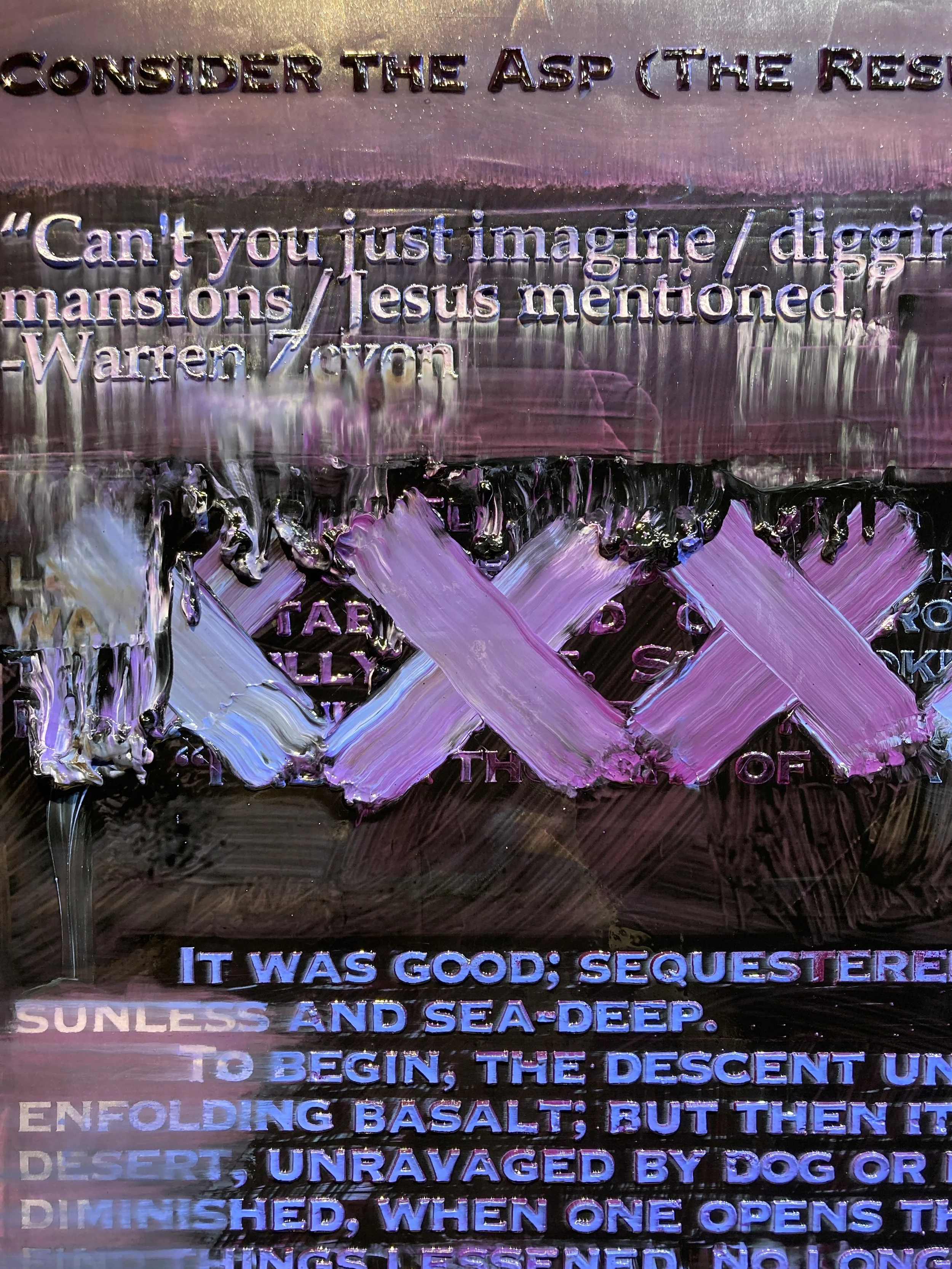
Detail from “Weather Gathering” 2026
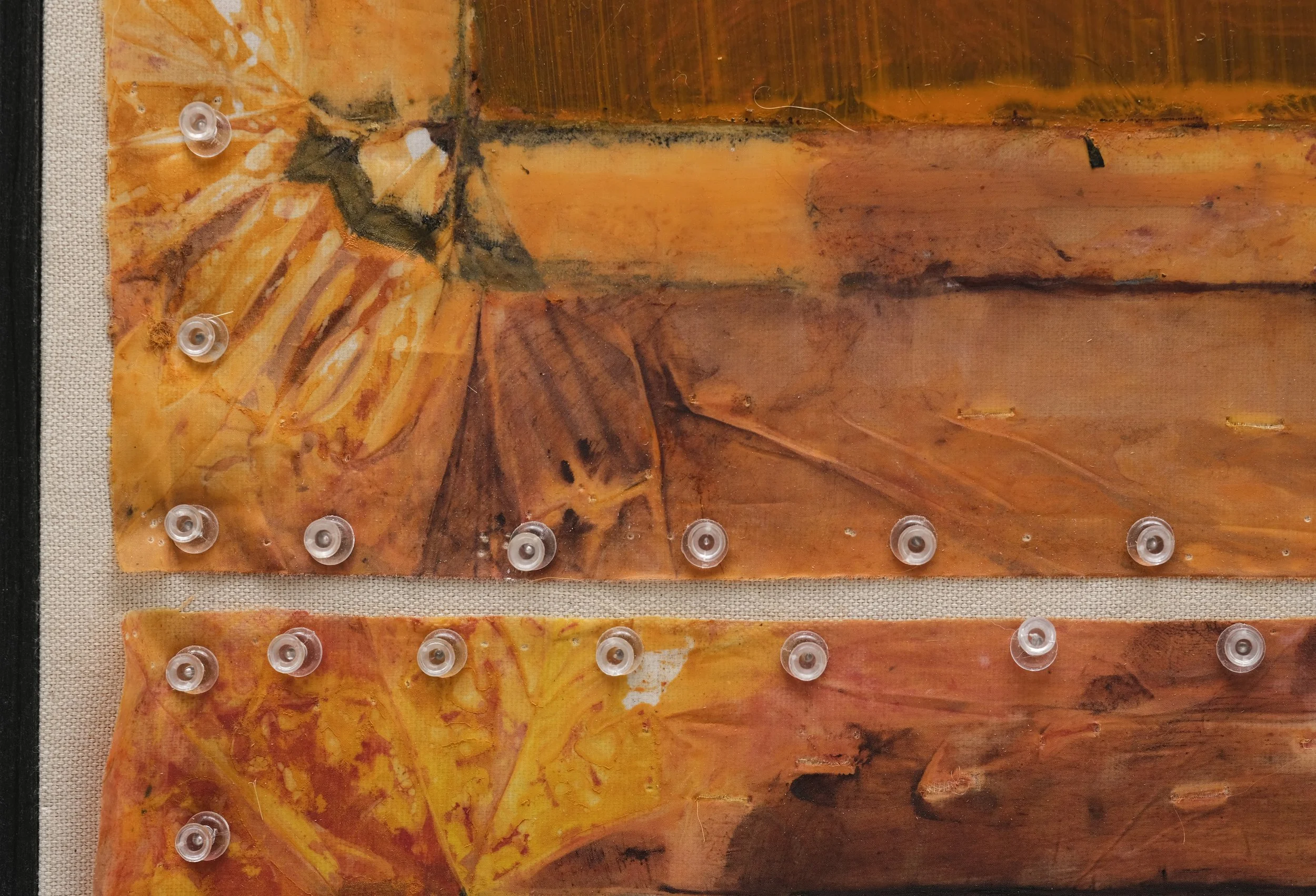
Detail from “The Old Guitarist” 2022
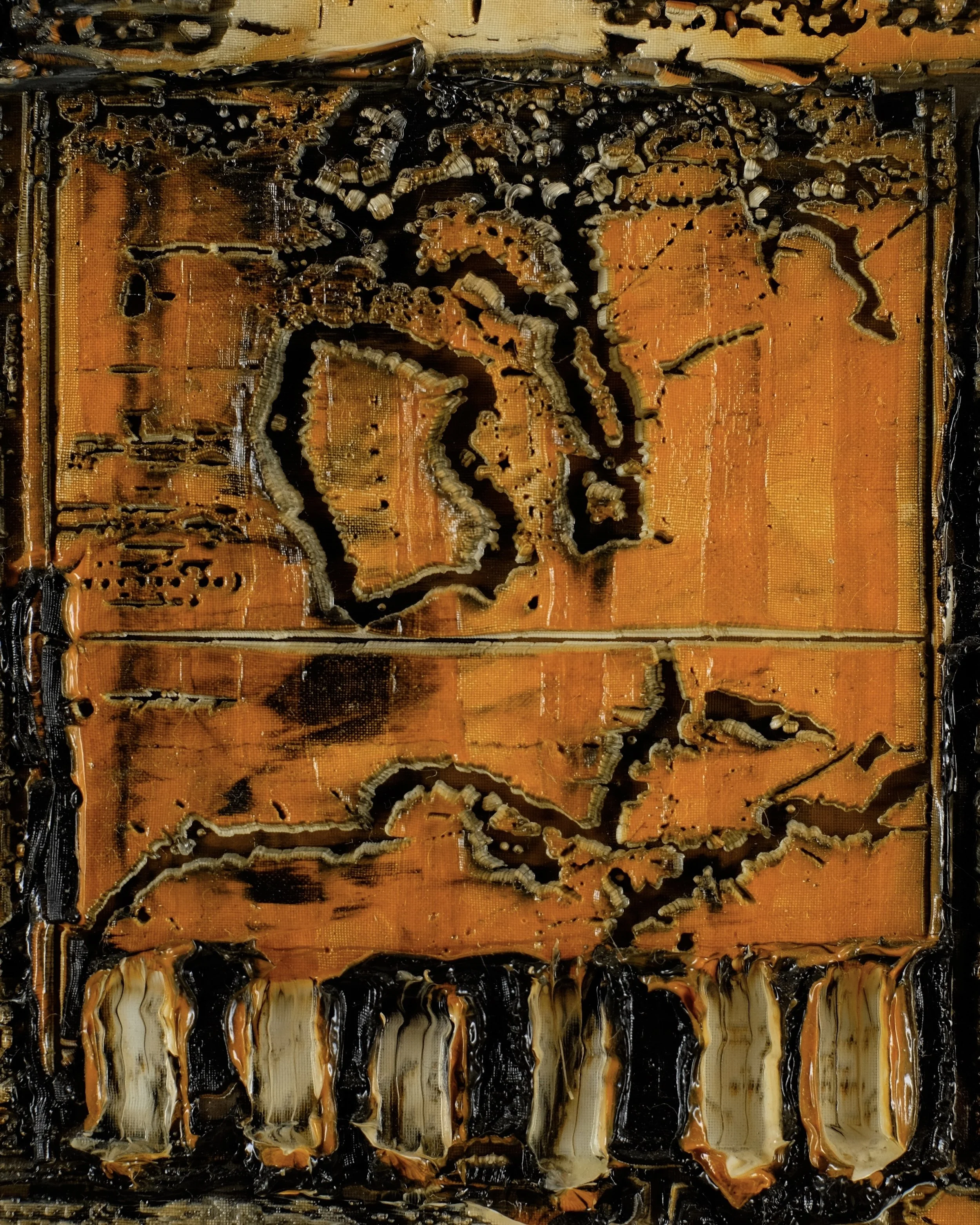
Detail from “Augur”