Fragment
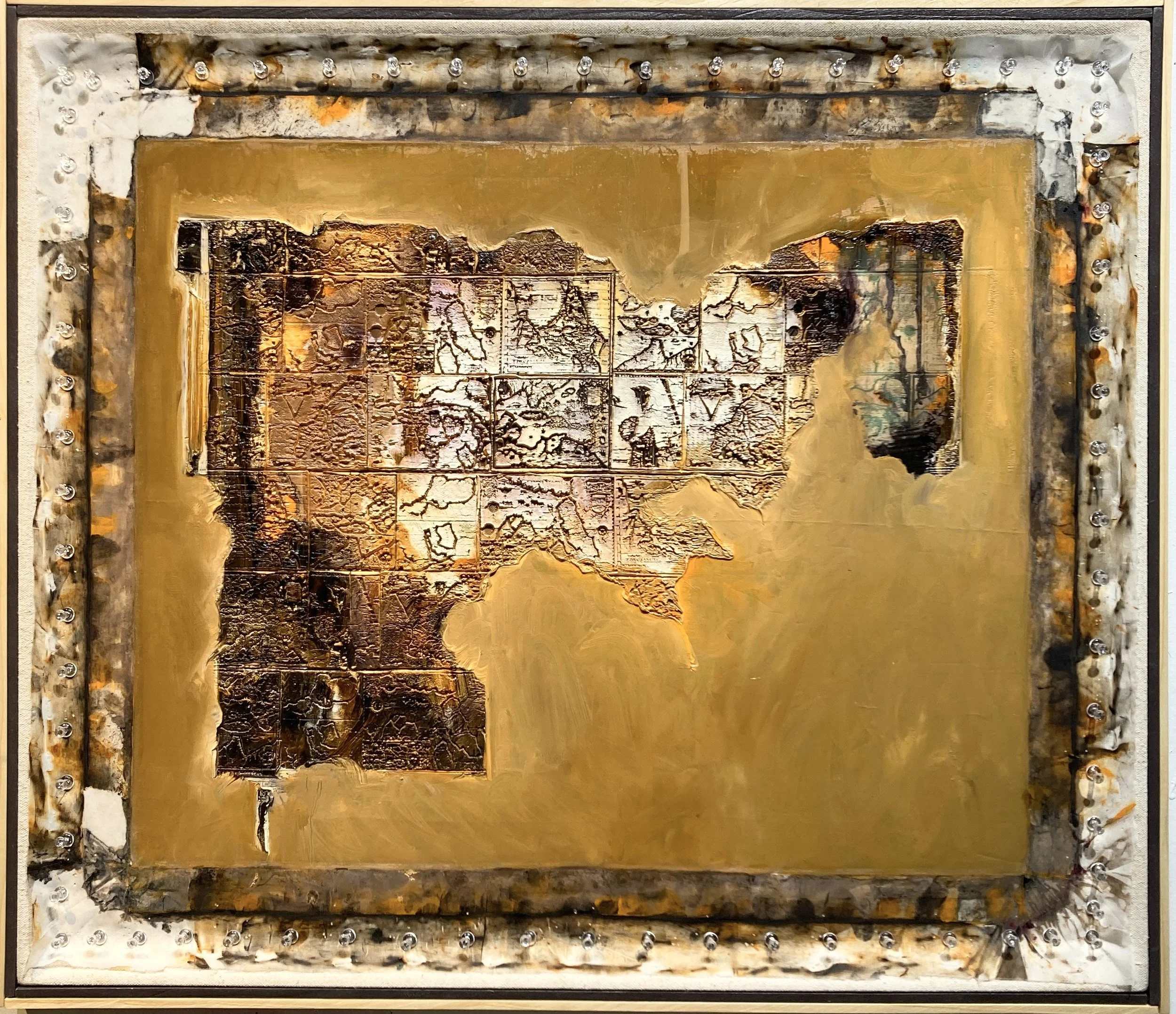
On Fragment
Most of the work discussed here arrives paired with language — a poem sitting alongside the painting, each unsettling the other's claim to say the last word. Fragment has no such partner: no text in it, none beside it. But strictly speaking, the language of visual art is exactly that — a language, as versatile and potent as any construction of nouns, verbs, and clauses, only the lexicon at work is one of color choices, echoed forms, imitation, and juxtaposition. A painting without a poem beside it isn't a painting without language; it's a painting speaking only in its own tongue. Sometimes that language is as obvious as it is in Axes Mundi, where the poem invokes pins as markers of an abstract idea while the painting is physically pinned to its support — the same image doing duty as metaphor and as structure. More often it works less consciously: decisions made intuitively during a piece's making are trusted rather than explained, and only reveal their logic later, if at all.
Fragment doesn't argue for this so much as behave as if it's obvious. Its structure is built from a grid of small, indexed map fragments — laid in like a set of citations, or specimens pinned for study — over which sits a field of warm ochre, painted in passages that suggest cracking and wear. That surface has a grammar not unlike a poem's line breaks or caesuras: concealment and disclosure, syntax withheld and then partially given back. The maps don't explain themselves, and the paint covering them doesn't either. What's left is closer to elision than statement — the kind of gap a reader is asked to complete in a poem, transposed into surface.
The relic idea mentioned elsewhere is particularly important here. Every painting becomes a relic the moment it's finished — an object that stops being a process and starts being the remainder of one. Fragment compounds that condition rather than simply inheriting it. Its material is already relic-like before the painting begins: maps are documents built toward their own obsolescence, instruments for crossing ground that, once crossed, render the map inert — kept, if at all, as a record of a passage already completed. Painting over that material doesn't neutralize its used-up quality; it repeats it, one kind of superseded object staged beneath another, so the painting becomes a relic performing the appearance of a relic.
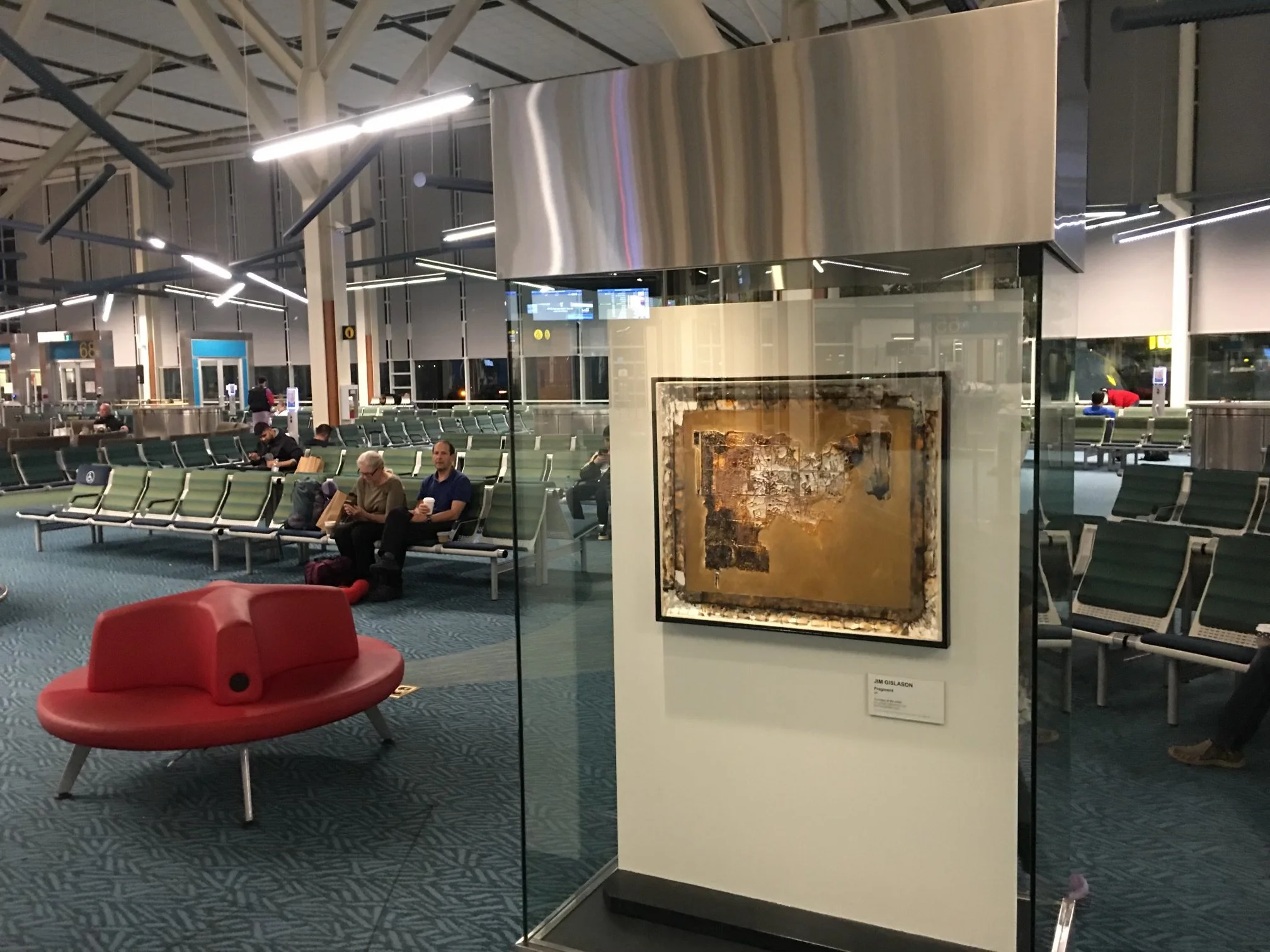
Fragment displayed in the international depatures lounge at Vancouver International Airport 2022-25.
Its subsequent life pressed the point further, if unintentionally. For several years, Fragment hung in the international departures area at Vancouver International Airport — not in a gallery, where a viewer arrives already prepared to look, but in a space built entirely around motion, where almost everyone passing it was mid-transit, unlikely to see it twice. A painting made from the residue of old journeys spent that stretch of its life presiding over new ones, largely unnoticed by the people making them. The overlap wasn't planned, but it's hard to think of a more literal setting for an object concerned with passage and its leftovers.
A related piece, Ghost Ship, built from the same cartographic fragments, arranges them into the silhouette of a tall ship under sail, and pushes this material toward something closer to narrative — one composed with the legend of the Flying Dutchman specifically in mind. The doomed ship of that story hails passing vessels and presses on them letters addressed to the long dead: spectral mail, correspondence still being delivered to recipients who stopped being able to receive it centuries before. Accepting it was thought to draw the receiving ship into the same curse — implicated in the Dutchman's fate simply by taking its post. What makes the legend useful here isn't the doom so much as its structure: time refuses to stay sequenced. A message sent under one set of conditions arrives, unaltered, into a moment that has no place left to put it.
That's the condition Fragment holds without narrating it. The maps are already a record of arrivals that have already happened — coastlines fixed once and then carried forward, unrevised, into every later moment that looks at them. Painting over them doesn't update the record; it just adds a second layer of "now" on top of a "then" that never stopped being legible underneath. The two don't resolve into a single timeline. They sit on the same surface, addressed to each other across a gap the painting doesn't try to close — the relic's fixed, completed past against the wet immediacy of paint that is, at least nominally, still present tense.
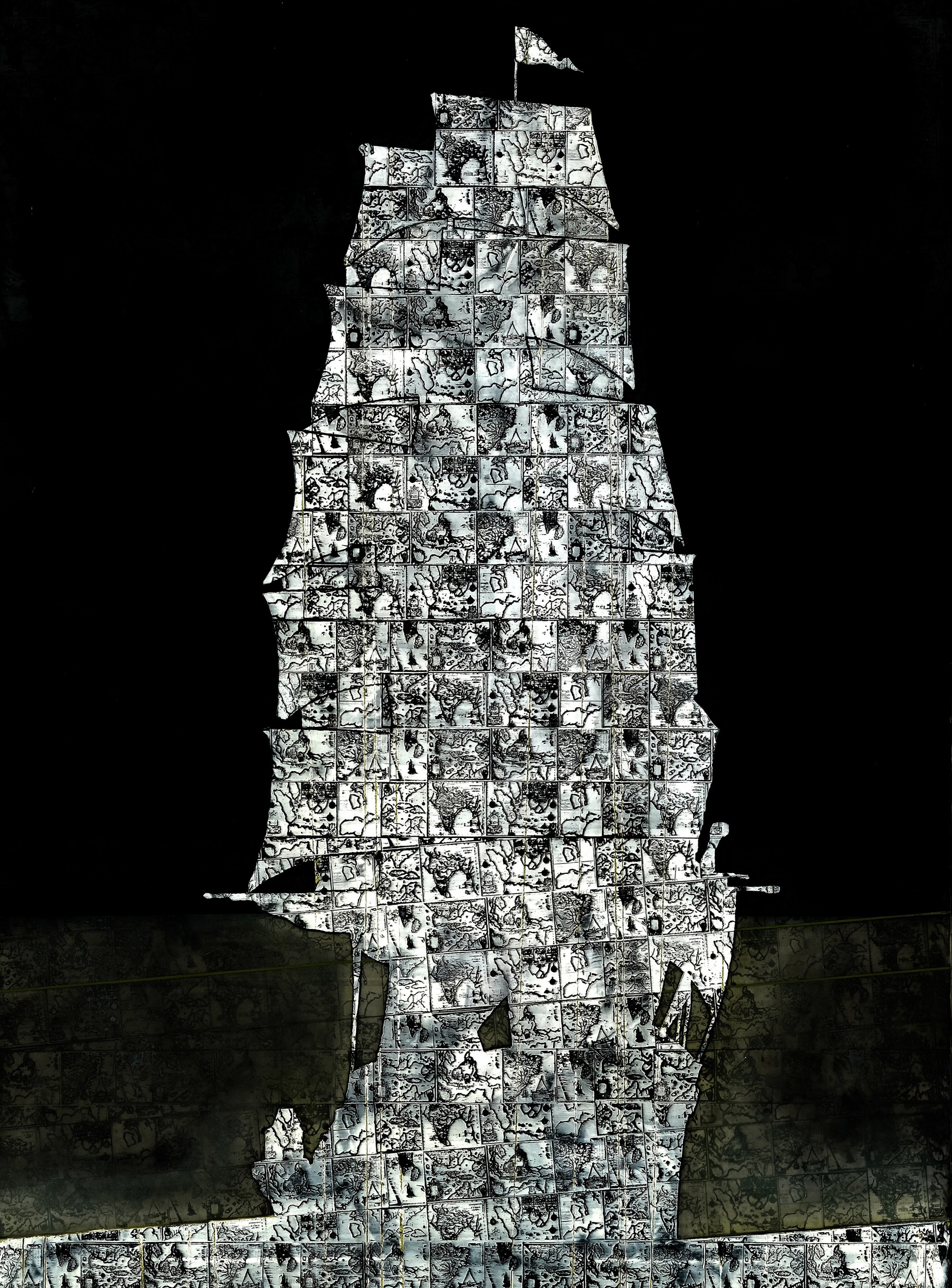
Ghost Ship archival print from original painting
Set beside Ghost Ship, which spells this arrangement out as a story — spectral mail arriving on schedule from nowhere, a curse transmitted by simple contact — Fragment keeps the same current running underneath a subject that offers no plot to hang it on. There's no ship here, no crew to receive the letter, no telling if delivery has already happened or is still pending. Only the maps, half-covered, still holding their old news, and paint that keeps performing an age it hasn't yet earned.
Standing in front of Goya's black paintings in Madrid, it's possible to feel that he is the largest presence in the room, despite having been gone for two centuries. That's not sentiment; it's closer to a fact about what art can do at its best — cut through elapsed time and render itself simply present, neither belated nor current, the way Augustine described eternity itself: never old, never new. If Fragment and Ghost Ship are, between them, staging an argument about time's refusal to stay sequenced, that argument may be less a subject the paintings have chosen than the ground every finished painting already stands on.
