Weather Gathering
Summary of Weather Gathering
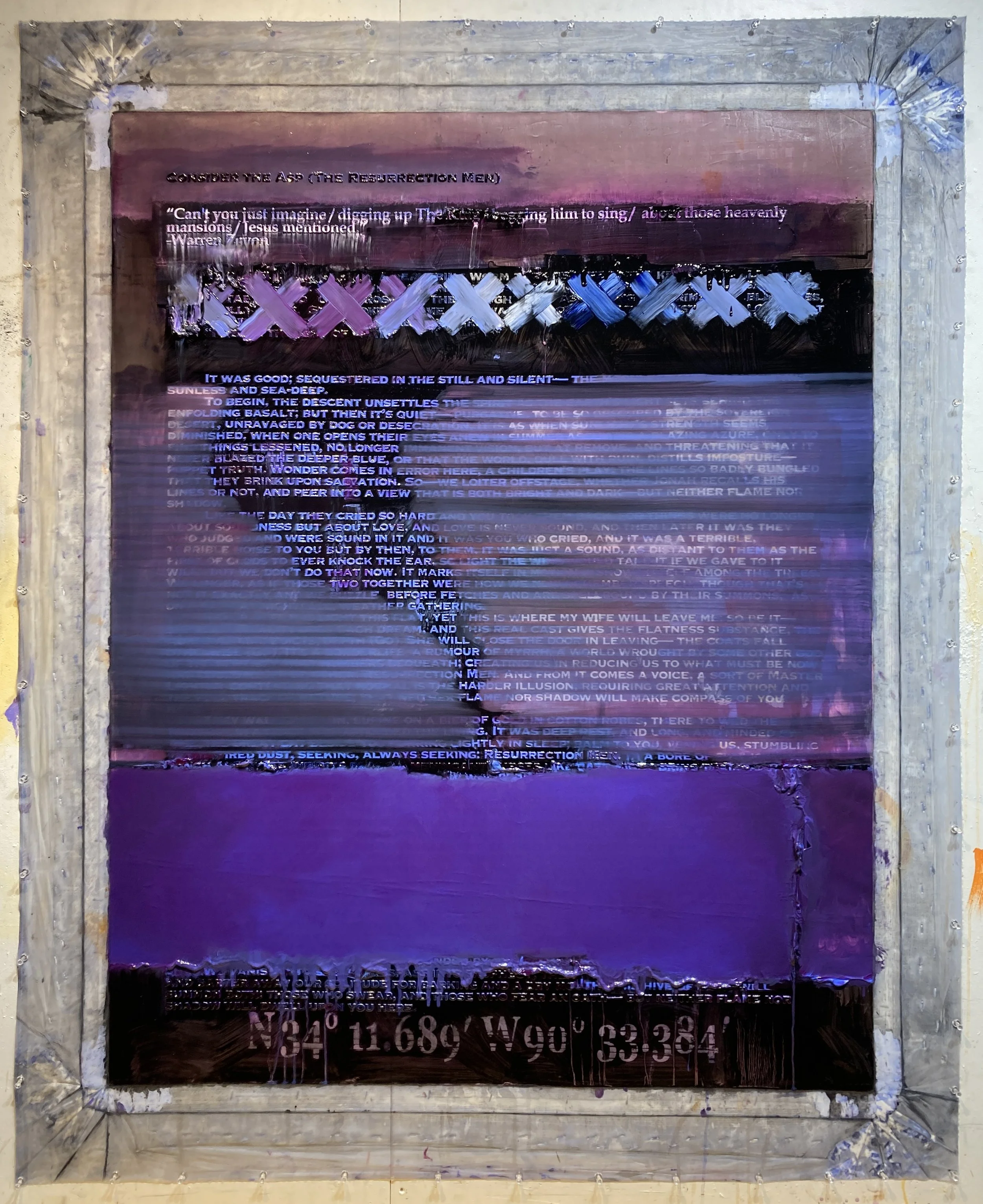
The phrase weather gathering originates in the poem Consider the Asp (The Resurrection Men), where it describes a moment when the ordinary world seems to gather forces beyond human understanding. Weather, in this sense, is not simply atmosphere or forecast. It is an event forming on the horizon — something sensed before it arrives. It is pressure, accumulation, and the awareness that something has begun to take shape.
The painting Weather Gathering begins with an interest in the way language and imagination can disclose meanings that are not immediately visible. The world does not necessarily offer signs or hidden messages waiting to be discovered; rather, through poetic thought, words and images can create structures through which deeper truths become perceptible. A phrase, an image, or a sound can become more than itself. Like the claps of thunder that become the “chimes of freedom” in Bob Dylan’s song, elements of the world can be transformed through imagination into expressions of inner and collective experience.
In this sense, Weather Gathering is not a painting about a storm as an external event. It is about the storm as an imaginative form — a way of giving shape to forces that exist within human consciousness, memory, and history. The tornado emerging within the landscape is not a prediction or an omen. It is an image through which something otherwise difficult to articulate becomes present.
The painting follows a belief, found throughout poetry, that imagination does not move away from reality but penetrates more deeply into it. For Wallace Stevens, imagination is not an escape from the world but a necessary means of perceiving it — the faculty through which the mind discovers relationships and meanings that ordinary perception cannot fully grasp. Weather Gathering explores this territory where language, image, and perception converge, where a landscape becomes not only a representation of the world but a way of thinking about the world.
The landscape in Weather Gathering is inseparable from language. The text embedded within the painting does not function as an inscription or explanation placed upon an image. Instead, language becomes part of the terrain itself. Words appear as layers of inscription: partially revealed, partially obscured, altered by the same processes that shape the image. The landscape becomes a kind of writing, and the writing becomes a kind of landscape — something accumulated over time, where meaning exists not only in what can be read but also in what remains hidden.
The obscured words suggest that meaning is not always encountered through clarity. Like weather itself, meaning gathers slowly. It emerges through fragments, interruptions, and traces. What has been covered over is not erased; it continues to exert a presence, like something beneath the surface whose shape can still be felt.
The coordinates within Weather Gathering belong to a recurring element within a larger body of paintings and poems. They refer to the crossroads in Mississippi where Robert Johnson is said to have made his legendary bargain with the devil. The coordinates appear as an act of precision and measurement, yet they point toward a place where history and myth, fact and belief, intersect. They locate a physical point while also suggesting the way certain places become charged through story, imagination, and human longing.
Rather than simply identifying a location, the coordinates function as a poetic marker — a point where the physical world and the imaginative world meet. They suggest that places are not only geographical but also shaped by the meanings that gather around them.
The painting exists within this tension between the measurable and the unknowable. A storm can be scientifically observed, but it can also become an imaginative form. A place can be mapped, but it can also become mythic. Language can describe the world, but through poetry and art it can also reveal relationships within the world that cannot be reduced to description.
Weather Gathering is not a painting of a storm approaching. It is a painting about the moment when imagination gathers the scattered elements of experience — language, image, history, and perception — into a form capable of revelation. It is a landscape at the edge of disclosure, where meaning does not appear as a hidden message waiting to be uncovered, but emerges through the transformative power of imagination itself.
