Axes Mundi (A Lament for Lorca)
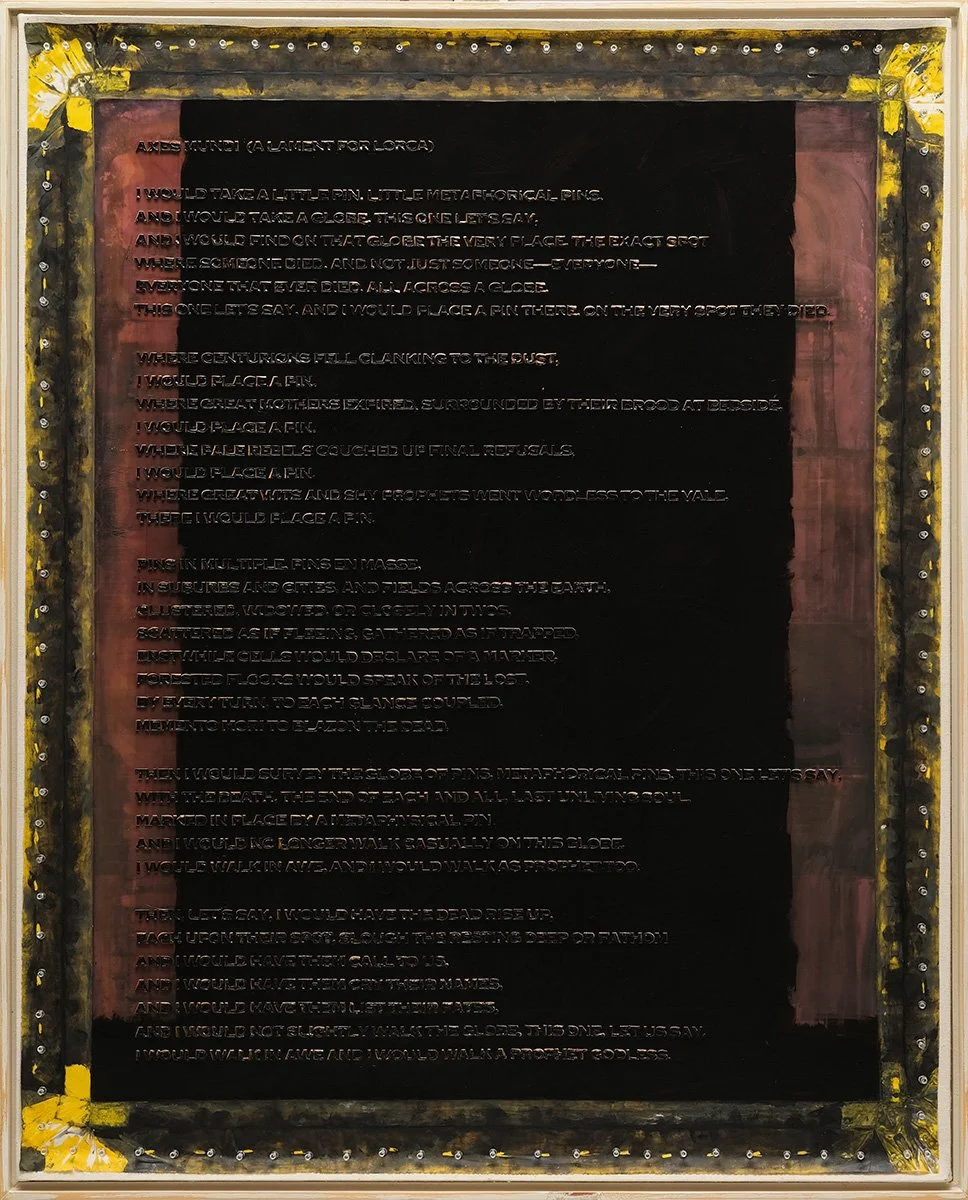
Axes Mundi (A Lament for Lorca)
I would take a little pin, little metaphorical pins, and I would take a globe, this one let’s say, and I would find on that globe the very place, the exact spot where someone died, and not just someone—everyone— everyone that ever died, all across a globe, this one let’s say, and I would place a pin there, on the very spot they died.
Where centurions fell clanking to the dust, I would place a pin. Where great mothers expired, surrounded by their brood at bedside, I would place a pin. Where pale rebels coughed up final refusals, I would place a pin. Where great wits and shy prophets went wordless to the vale, there I would place a pin.
Pins in multiple, pins en masse, in suburbs and cities, and fields across the earth, clustered, widowed, or closely in twos, scattered as if fleeing, gathered as if trapped, erstwhile cells would declare of a marker, forested floors would speak of the lost, by every turn, to each glance coupled, memento mori to blazon the dead.
Then I would survey the globe of pins, metaphorical pins, this one let’s say, with the death, the end of each and all, last unliving soul, marked in place by a metaphysical pin and I would no longer walk casually on this globe. I would walk in awe, and I would walk as prophet too.
Then, let’s say, I would have the dead rise up, each upon their spot, slough the resting deep or fathom and I would have them call to us, and I would have them cry their names, and I would have them list their fates, and I would not slightly walk the globe, this one, let us say. I would walk in awe and I would walk a prophet godless.
Summary of Axes Mundi (A Lament for Lorca)
Axes Mundi (A Lament for Lorca) imagines what the world would become if the hidden accumulation of every human death were suddenly made visible. It proceeds by asking what would happen if every human death could be marked upon the earth. The speaker imagines placing "little metaphorical pins" into a globe at the precise location where every human being has died. What begins as a simple conceit gradually assumes the force of revelation. The globe becomes a map of human mortality on which every death, known and unknown, occupies an irrevocable place. The poem does not imagine a different world; it imagines seeing this world truthfully.
The subtitle, A Lament for Lorca, provides an important interpretive key. Federico García Lorca disappeared into the anonymous violence of the Spanish Civil War, executed and buried in an unmarked grave whose exact location remains uncertain. His death has come to symbolize not only political murder but the countless unnamed dead lost to history. The poem transforms Lorca's fate from a singular tragedy into a universal condition, making his unmarked death emblematic of every life lost to history, violence, or anonymity. Rather than memorializing a single poet, it imagines a world in which every death is made equally present.
This movement from the individual to the universal is established almost immediately. The speaker begins by seeking the place "where someone died," only to interrupt the thought with the correction: "and not just someone—everyone." History often privileges exceptional deaths—the famous, the heroic, or the tragic—but the poem refuses such distinctions. Centurions, mothers, rebels, prophets, and unnamed figures all receive the same gesture of marking. The repeated refrain, "I would place a pin," assumes the rhythm of ritual, transforming the act into a kind of metaphysical accounting of the dead.
The catalogue that follows disregards chronology and hierarchy. Roman soldiers stand beside mothers surrounded by family, political dissidents beside "great wits and shy prophets." Their final moments are described not through triumph but through physical diminishment: they fall, expire, cough, and finally become wordless. Even prophets lose language before death. Mortality levels every human distinction while preserving the singularity of each life through the act of marking.
As the catalogue expands, geography itself begins to function as testimony. Forest floors "speak of the lost," and the earth appears to acquire its own memory. The globe ceases to function as a neutral object and instead becomes a vast archive of human absence. The traditional memento mori is no longer represented by a symbolic object but by the world itself. Every location becomes a reminder of mortality, every landscape a repository of lives that have passed into silence.
The emotional centre of the poem arrives with the recognition that such knowledge would fundamentally alter human experience:
"I would no longer walk casually on this globe."
Nothing supernatural has occurred. The earth remains unchanged. Only perception has changed. Yet that shift transforms ordinary existence. The world has not become sacred through alteration; rather, its hidden sacredness has been revealed. Walking becomes an encounter with a reality that was always present but ordinarily concealed.
The poem's final movement initially evokes the language of resurrection. The dead rise upon the places where they died, but their return does not offer the consolations traditionally associated with resurrection. They return in order to testify. They call their names and recount their fates. The emphasis rests not upon redemption but upon revelation. The dead refuse disappearance by forcing the hidden history of the earth into consciousness.
The concluding declaration—"I would walk in awe and I would walk a prophet godless"—introduces one of the poem's central paradoxes. Prophecy is retained while divine certainty is withheld. The speaker assumes the burden of witness without claiming theological authority. The prophetic role is not to announce a divine order but to bear the weight of an unveiled reality. The poem's final transformation is therefore not moral instruction but a changed condition of seeing.
The invocation of Lorca reinforces this understanding. Lorca's work is deeply associated with what he called duende: a dark creative force that arises through confrontation with mortality rather than escape from it. Unlike inspiration conceived as divine grace or technical mastery, duende emerges from struggle with death, suffering, and the limits of human existence. Axes Mundi shares this orientation. Its imaginative power derives not from promises of transcendence but from an uncompromising encounter with mortality and the forces that surround it.
The title carries the poem's culminating symbolic gesture. Axes mundi is the plural of axis mundi, the traditional term for the singular point at which heaven, earth, and the underworld intersect—a sacred mountain, tree, temple, or cross through which the cosmos is ordered. The poem disperses that singular centre across the entire globe. Every place where a human being has died becomes an axis mundi, a point at which the living and the dead continue to meet. Rather than locating sacredness in one privileged place, the poem multiplies the sacred centre until the entire earth becomes a field of intersections between mortality and meaning.
Ultimately, Axes Mundi is less concerned with death itself than with the revelation of what death has always made true. The imagined globe of metaphorical pins serves as a figure for a consciousness incapable of moving casually through the world. Every landscape is understood as layered with hidden histories, every place as bearing the presence of those who have passed through it. The poem concludes by suggesting that awe arises not from escape from mortality but from the willingness to inhabit a world in which every place has become an axis mundi.
