The Old Guitarist
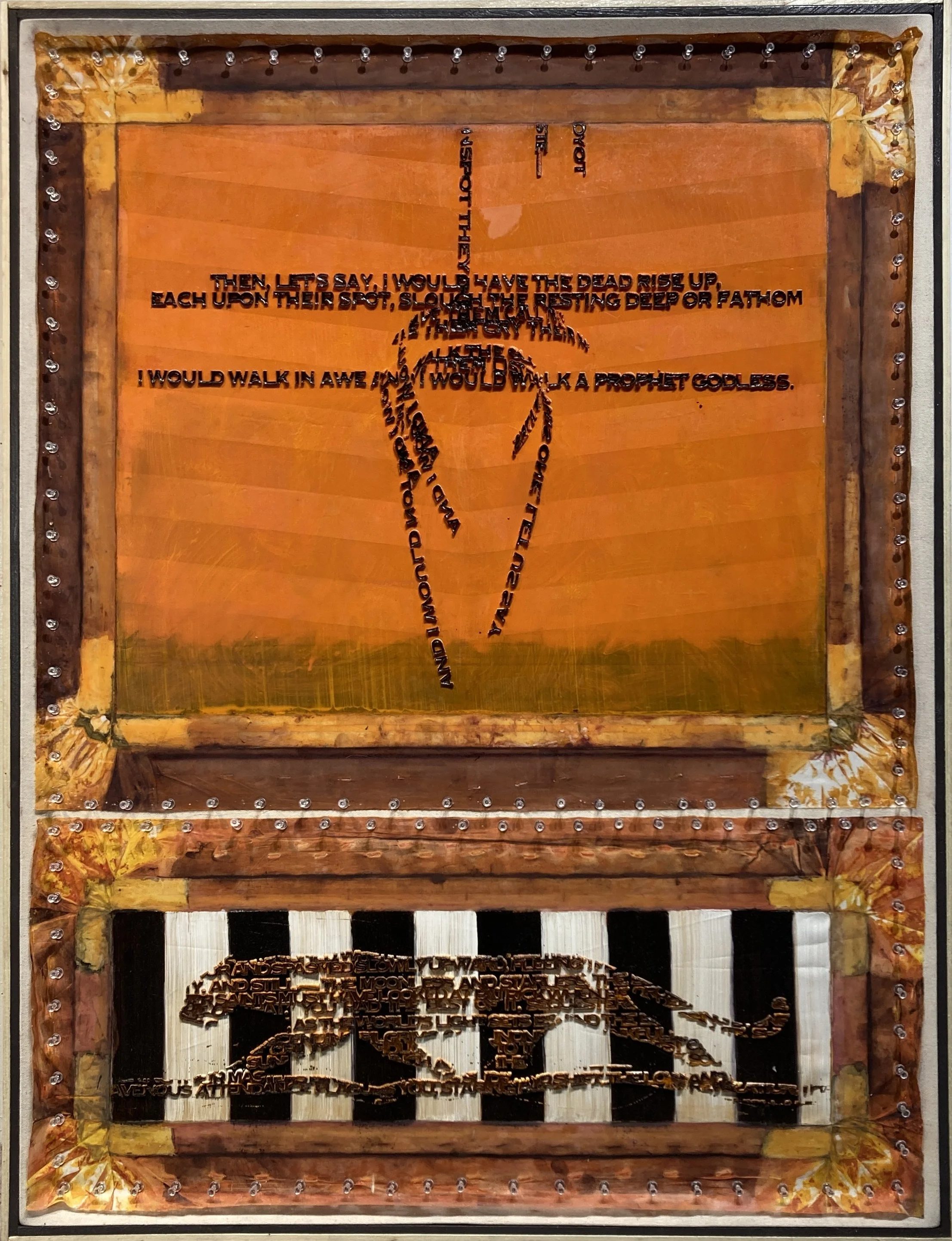
The Old Guitarist
A spider sees me. More than one. Minding my business on a cool morning I pass before them oblivious. Covetous eyes watch me in the morning sun.It is prey. It is not. This blood corsage. A leg shifts imperceptibly and stifled instinct shudders the web. In Chicago, someone dims the lights on The Old Guitarist.We are lost in the heat of particulars. He and I. Believe it. Our outsized prey elude us, his sanguine, mine a falling lodestarbeyond the filament of my vision. There even seems a rippling there, as if a wind is kicking up among the uncarnate, despite the collisionof two so thrown together, so beguiled by circumstance. Here in the crucible garden, with the Black-eyed Susans and sun, the day is done, the shadow is passed and thick has the web got, shrouded by chance.
Summary of The Old Guitarist: Poem and Painting
The poem and painting share a name with Picasso's famous blue period work, but they don't illustrate it — they use it as a vanishing point, a distant reference that organizes the work's deeper concerns without being its subject. The gesture is oblique and confident: Picasso's guitarist is invoked and then left in Chicago, dimly lit, while the poem does its own work in a crucible garden among Black-eyed Susans.
The poem opens in a domestic, unheroic register — a person minding their business on a cool morning, moving through garden space, unaware of being watched. The spiders are already there. They see before they are seen, and that priority of vision establishes the poem's central dynamic: the watcher and the watched, the predator and the prey, scaled and rescaled across three registers. The spider watches the human. The human watches the Picasso. Something watches — or fails to watch, or moves through the world as pattern rather than presence — everything.
This is the poem's triumvirate: spider, artist, god. What holds them together is not hierarchy but structural analogy. Each works a filament toward something beyond its reach. The spider works the web. The guitarist works the strings. The idea of god works through the world as web, as pattern, as the felt pressure of something organizing experience without declaring itself. None of them catches what they're after. The spider's prey is the human, outsized and oblivious. The guitarist's prey is the sanguine — blood, feeling, the fullness of life rendered in music. The speaker's prey is a falling lodestar, the transcendent receding beyond the filament of vision. Three scales of pursuit, three failures of capture, all formally equivalent.
The painting enacts this structurally rather than illustrating it. The spider is made of language — text bent and shaped into the form of the creature, suspended in the burnt orange upper field as both predator and text. The figure dangles as spiders do, occupying the threshold between stillness and sudden motion, between web and prey. That it is constituted by words makes it the poem's central conceit rendered literally: meaning as predatory, patient, structural. The web is the medium. If the spider works a web like a guitarist works strings like god works the world, then a spider constituted by language is a figure for how meaning itself moves — not declared, but structural, felt through the filament rather than seen directly.

Original British Columbia film classification logo, 'Restricted' rating, predating the introduction of the PG category.
The lower panel makes the triumvirate visible as image. The panther — borrowed from the restricted-film symbol, that black cat marking what cannot be shown, what is withheld from general access — becomes the figure for transcendence itself. Not god declared but god as that which is cordoned off, restricted, present as a category of the forbidden or the beyond-reach. It is what the guitarist reaches toward, what the speaker's lodestar gestures at, what the spider cannot eat because it is too large and too dark and moves by different rules entirely. The two registers of the painting map precisely onto the poem's structure: spider above, restricted transcendence below, and between them the web — which is also the strings, which is also whatever pattern moves through the world just below the threshold of sight.
The poem closes on three figures that echo each other without hierarchy. The spider works its web; the guitarist works the strings; the person moves through an ordinary morning casting the invisible filaments of attention and longing that make a life. These are not separate activities — they are the same motion at different scales, and the web and the strings are the same thing: the vital force that connects, that reaches, that binds experience into pattern and meaning. We are all always working this web, whether we know it or not. It is not the province of the heroic or the exceptional. It is what living does.
And behind all of it, the panther — transcendence, god, the eternally restricted, the thing that cannot be shown — moves in its own register, neither web nor strings but the darkness that gives both their tension. It is what the web is spun toward, what the strings are reaching for, what the ordinary person in the garden feels as the lodestar falling just beyond sight. The old guitarist of the title is not Picasso alone. It is the spider, worn and patient. It is any person, conscious and longing, working whatever filament they have. It is the vital force itself, oldest of all, still playing a music we can feel in the web but never quite hear directly.
