Consider the Asp
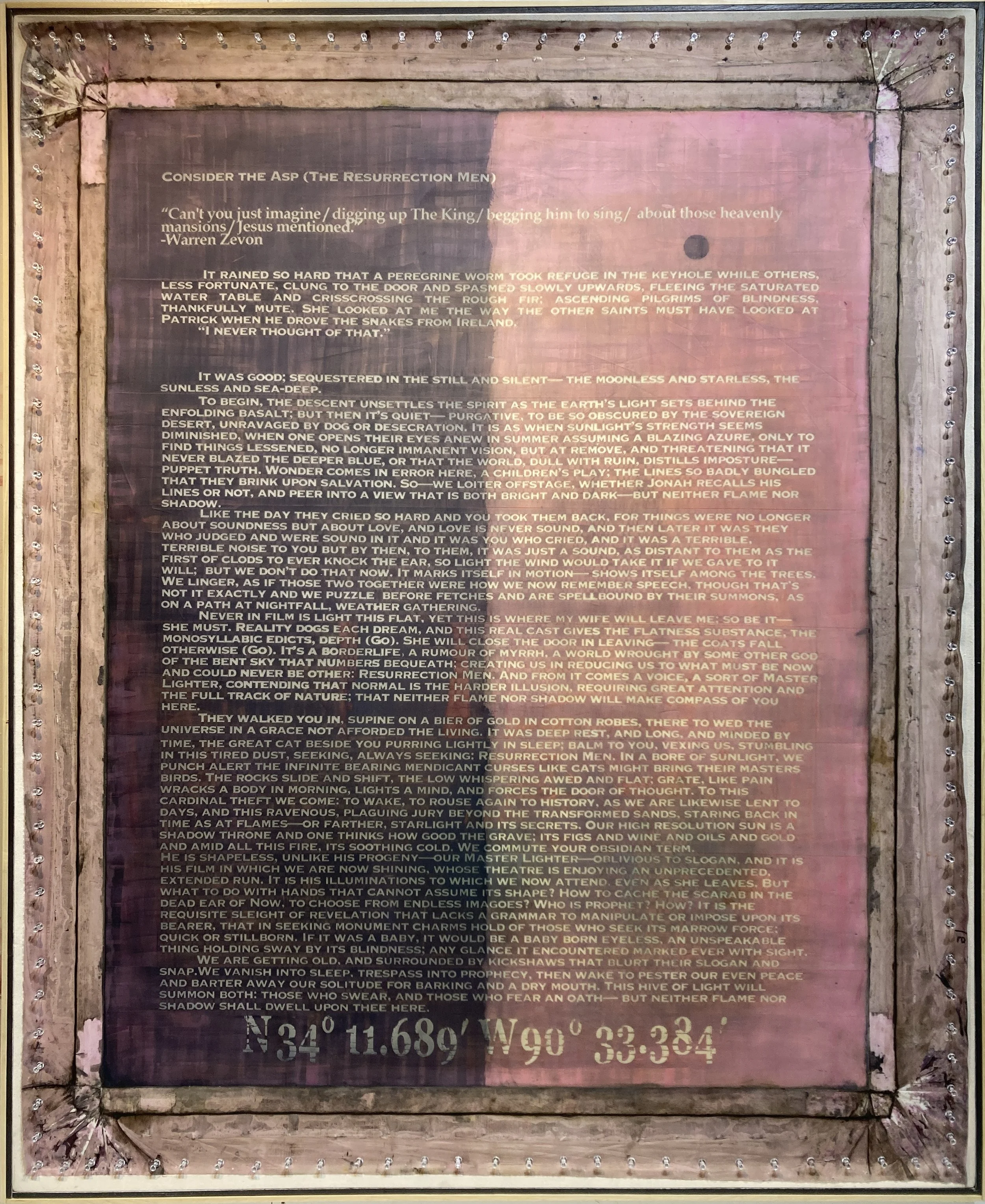
Consider the Asp (The Resurrection Men)


“Can't you just imagine / digging up The King /
begging him to sing / about those heavenly mansions /
 Jesus mentioned.”
—Warren Zevon


It rained so hard that a peregrine worm took
refuge in the keyhole while others, less fortunate,
clung to the door and spasmed slowly upward,
fleeing the saturated water table and crisscrossing
the rough fir; ascending pilgrims of blindness,
thankfully mute. She looked at me the way the other
saints must have looked at Patrick, when he drove the
snakes from Ireland.
“I never thought of that.”

                                         * * *


It was good;
                       sequestered with silence,

surety, and still;
the moonless and starless,
			                   the sunless
and sea-deep.

To begin,
	      the descent unsettles the spirit

as the earth’s light sets
behind the enfolding basalt;

but then it’s quiet—purgative, to be so obscured
by the sovereign desert,
			                unravaged
by dog or desecration.

It is as when sunlight’s strength
seems diminished,
		              when one opens their eyes

anew in summer,
		           assuming a blazing azure

only to find things lessened,
no longer immanent vision,

              but at remove, and threatening

that it never blazed the deeper blue, or
that the world,
		          dull with ruin,

distils imposture—puppet truth.

Wonder comes in error here,
			                      a children’s play;

the lines so badly bungled
that they brink upon salvation. So—

                           we loiter offstage,

whether Jonah recalls his lines or not
and peer into a view

                            that is both bright and dark—

                            but neither flame nor shadow.


Like the day they cried so hard
and you took them back,
			                for things

were no longer about soundness
                                       but about love,

and love is never sound,
and then later it was they who judged

		                      and were sound in it

and it was you who cried,

and it was a terrible, terrible noise to you
but by then, to them,
			              it was just a sound,

as distant to them as the first of clods
to ever knock the ear,

so light the wind would take it,
			              if we gave to it a will;

	     but we don’t do that now.

It marks itself in motion—
shows itself among the trees.

                                      We linger,

as if those two together
              were how we now remember speech,

though that’s not it exactly

               and we puzzle before fetches,
               and are spellbound by their summons

as on a path at nightfall,

                                      weather gathering.


Never in film is light this flat,
yet this is where my wife will leave me;

so be it,
	    she must.

Reality dogs each dream,
and this real cast

gives the flatness substance;
              the monosyllabic edicts depth. (Go).

She will close the door in leaving—

              the coats fall otherwise. (Go).

It’s a borderlife,
a rumour of myrrh, a world

wrought by some other god
              of the bent sky that numbers bequeath;

              creating us in reducing us,
to what must be now and could never be other:

                                                  Resurrection Men.


And so there remains a voice,

a sort of Master Lighter,
contending that normal is the harder illusion,

requiring great attention,
  			                  and the full track of nature;


that neither flame nor shadow

			                  will ever light upon you.


They walked you in, supine
              on a bier of gold in cotton robes,

there to wed the universe
                             in a grace not afforded the living.

It was deep rest, and long,
and minded by time,

		            the great cat beside you
                            purring lightly in sleep;

balm to you,
		            vexing us,
stumbling in this tired dust,

		            seeking, always seeking:

Resurrection Men.


In a bore of sunlight, we punch alert the infinite
bearing mendicant curses

              like cats might bring their masters birds.

The rocks slide and shift,
			                   the low whispering
                                           awed and flat;

grate, like pain wracks a body in morning,

lights a mind
                             and forces the door of thought.

To this cardinal theft we come; to wake,
	      to rouse again to history

    	      as we are likewise lent to days,

and this ravenous, plaguing jury
              beyond the transformed sands,

stares back in time as at flames—or farther,

             starlight and its secrets.

Our high-resolution sun is a shadow throne
             and one thinks how good the grave;

its figs and wine and oils and gold
and amid all this fire, its soothing cold.

We commute your obsidian term.


He is shapeless, unlike his progeny—
our Master-Lighter—

oblivious to slogan,

                    and it is his film in which we are now shining,

whose theatre is enjoying an unprecedented,
                    extended run.

It is his illuminations
to which we now attend,
                                          even as she leaves.

But what to do with hands that cannot assume its shape?
How to cache the scarab

in the dead ear of Now,
to choose from endless imagoes?

Who is prophet? How?

It is the requisite sleight of revelation
                   that lacks a grammar to manipulate

                   or impose upon its bearer,

that in seeking monument charms hold
              of those who seek its marrow force;

			                 quick, or stillborn.


If it was a baby,
it would be a baby born eyeless,

an unspeakable thing
	     holding sway by its blindness;

any glance it encountered
                                        marked ever with sight.


We are getting old
and surrounded by kickshaws,

	    that blurt their slogan and snap.

We vanish into sleep,
	    trespass into prophecy,

then wake to pester even peace
and barter off our solitude;

           for barking and a dry mouth.


This hive of light will summon both:
those that swear and those that fear an oath,

but neither flame nor shadow
	  shall dwell upon thee here.
Summary of Consider the Asp (The Resurrection Men)
Consider the Asp is a meditation on death, memory, love, burial, resurrection, and the human desire to find meaning in a world where revelation remains uncertain. The poem moves associatively rather than narratively, circling its concerns through images of worms, saints, tombs, desert landscapes, mythic figures, spouses, cats, and the dead.
The poem begins after a heavy rain. Worms flee the flooded earth, climbing a door and sheltering in a keyhole. The speaker describes them as “ascending pilgrims of blindness,” transforming a mundane natural event into something resembling a religious procession. A companion's response evokes Saint Patrick driving the snakes from Ireland, immediately establishing one of the poem’s central tensions: the human tendency to interpret ordinary phenomena through myth, faith, and symbolic meaning.
From this opening, the poem descends into an imagined burial. The speaker reflects on the strange peace of being hidden beneath the earth, beyond light, noise, desecration, and the demands of ordinary life. Burial becomes not merely death but a state of removal from history and confusion. The darkness of the grave offers relief from a world increasingly experienced as uncertain, diminished, and mediated by what the poem calls “puppet truth”—a reality that seems staged, artificial, or falsely illuminated.
Throughout the poem, language itself becomes suspect. Speech is repeatedly shown as inadequate, distorted, or detached from genuine understanding. Memories of love, judgment, grief, and reconciliation emerge, but they are filtered through distance and uncertainty. Human voices, commands, and explanations seem unable to penetrate the deeper mysteries that concern the speaker.
A recurring figure is the speaker’s wife. At one point she is imagined leaving him, closing a door behind her and issuing simple commands: “Go.” Her departure introduces the reality of separation and mortality. Yet her presence also grounds the poem in lived experience and human affection, preventing it from becoming entirely abstract.
The poem repeatedly invokes religious and mythological imagery—Jonah, saints, resurrection, revelation, burial rites, scarabs, and prophetic visions—but treats these symbols ambiguously. The speaker appears drawn to transcendence while simultaneously doubting every system that claims to explain existence. Meaning is sought, but every revelation seems unstable or incomplete.
Central to the poem is the idea of the “Resurrection Men.” Historically, resurrection men were grave robbers who exhumed bodies. Here the phrase becomes a metaphor for humanity itself. We are portrayed as beings endlessly attempting to recover what has been lost: certainty, faith, truth, the dead, or some vanished authority capable of making sense of existence. Like grave robbers, we keep digging into the past, hoping to animate what no longer lives.
The image of a great cat sleeping beside the dead introduces a note of tenderness amid the metaphysical searching. The cat serves as a companion to the deceased, a symbol of continuity and comfort that contrasts with the restless activity of the living, who continue searching, interpreting, and questioning.
By the end, the poem remains suspended between belief and skepticism, illumination and obscurity. It rejects simple answers while continuing to yearn for revelation. Its closing vision suggests that neither certainty (“flame”) nor negation (“shadow”) can ultimately contain human experience. Instead, the poem inhabits the uneasy space between them, where meaning remains elusive but the search itself persists.
Excavating Meaning: Consider the Asp (The Resurrection Men) and the Painted Poem
Consider the Asp (The Resurrection Men) exists simultaneously as poem and painting, but the relationship between the two is not illustrative. The painting does not depict the poem; rather, it contains it. The poem is treated as one material among many—wood, pigment, push pins, stains, typography, and geography—each occupying the same physical and symbolic plane. The result is not a picture accompanied by text but an object that requires excavation.
This distinction is fundamental. Ordinarily a poem invites the reader directly into language. Here, language itself has become material. The text is embedded within a weathered, constructed surface and is physically difficult to read. One must approach it, stand before it, and patiently recover its words. Reading becomes an act of excavation, a fitting gesture for a work whose governing metaphor is the "Resurrection Men"—historical grave robbers who unearthed the dead in search of knowledge. The viewer performs the poem's central action before fully encountering its subject.
The painting resembles less a conventional canvas than an object recovered from another place. Its timber surround, distressed surfaces, muted earth colours, and worn edges evoke an archaeological panel, a weathered sign, a reliquary, or a fragment preserved from an uncertain history. The poem appears not printed upon the work but embedded within it. Language becomes something recovered rather than simply read.
The coordinates painted along the lower edge belong to a recurring geographical vocabulary within the artist's work. Rather than functioning simply as descriptive locations, they establish the possibility that particular places can become repositories of mythic or imaginative significance. Geography, like language, is permitted to carry meanings beyond its literal function, suggesting that the physical world itself may be read as a field of accumulated stories, beliefs, and acts of attention.
Visually, the painting is divided into two chromatic fields, one darker and one lighter. Neither dominates. The division quietly echoes one of the poem's recurring refrains: "neither flame nor shadow." Rather than illustrating that phrase, the painting enacts it. The viewer occupies a visual threshold between illumination and obscurity, certainty and doubt.
Distance also becomes part of the work's meaning. From across the room the poem dissolves into texture; only through close attention does texture become language. The painting therefore embodies one of the poem's central concerns: that meaning is neither immediately given nor permanently concealed. It emerges gradually through sustained acts of looking.
The repeated push pins surrounding the work reinforce this provisional quality. They resemble the means by which maps, notices, field reports, or collected fragments are temporarily fixed in place. Rather than sealing the work closed, they suggest an ongoing process of gathering and arrangement, as though the painting remains part of an investigation rather than a finished declaration.
What ultimately distinguishes the work is that it refuses the expressive model common to much contemporary text-based art. It does not present language for admiration or illustration. Instead, it functions as an object of sustained attention. Its purpose is not to communicate a message immediately but to alter the viewer's mode of perception, slowing the act of looking until attention itself becomes the medium through which meaning is encountered.
This reveals a broader concern running through both the painting and the poem. Their subject is not death, religion, or mythology in isolation, but the conditions under which meaning becomes possible. The worms climbing a door, the buried dead, the cat beside the tomb, the coordinates, the weathered wood, and the embedded poem all insist upon prolonged attention. Ordinary things are not transformed into symbols by artistic declaration. Rather, through sustained attention they disclose depths that were already present, revealing the world as more inexhaustible than first appearances allow.
The painting therefore functions less as an image than as a marker. Like a survey flag or an archaeological marker, it does not announce that meaning has been discovered but indicates where careful attention should begin. In this sense, the viewer becomes one of the Resurrection Men. The work asks not merely to be seen or read, but to participate in the slow recovery of meaning—not by inventing significance, but by uncovering what attentive looking has the capacity to reveal.
